

Table of Contents
- Where to Buy Vintage Cowboy Boots Online
- Local Shops and In-Person Vintage Boot Shopping
- How to Identify Authentic Vintage Cowboy Boots
- Vintage Cowboy Boot Sizing Guide
- How to Restore Vintage Leather Boots
- What to Expect When You Buy Vintage Cowboy Boots
- Frequently Asked Questions
Last Updated: October 3, 2026
Where to Buy Vintage Cowboy Boots Online
The best places to buy vintage cowboy boots in 2026 split into two camps: large online marketplaces with endless inventory and specialty boutiques that curate every pair by hand. The global cowboy boots market hit USD 307.7 million in 2025 and is growing at 6.8% through 2032, according to Maximize Market Research's cowboy boots market report, which means more buyers are chasing fewer quality vintage pairs. That's exactly why knowing where to look matters. At Gold Dogs, our Seattle shop has sold vintage and new western styles since 2011.
Online Marketplaces for Vintage Boots
eBay, Etsy, and shopgoodwill.com remain the volume leaders for secondhand western footwear. eBay is where serious sellers build reputations over decades. Elyssa's Vintage Cowboy Boots has spent 19 years selling on the platform and holds a 100% positive feedback rating, per eBay seller data. That kind of track record is your best signal on any marketplace.
Here's what to watch for on each platform:
- eBay: Deepest inventory, strongest seller feedback history, but condition varies wildly
- Etsy: Better curation, higher prices, more vintage-inspired reproductions mixed in
- shopgoodwill.com: Occasional steals, zero authentication, final sale on most listings
The catch with all three: you can't touch the leather before you buy. Ask for sole photos, interior stamping shots, and measurements before committing.
Specialty Vintage Boutiques
Curated boutiques beat general thrift outlets for handpicked quality, according to Pinto Ranch's vintage western apparel coverage. The trade-off is price and limited sizing. A boutique buyer has already filtered out the cracked soles and synthetic uppers, so you pay for that labor.
High-quality vintage cowboy boots can sell for over $1,000, with rare pairs going substantially higher, per Fibre2Fashion's vintage western footwear reporting. Vintage-inspired new boots sit lower: the Stetson Casey runs $350, per InStyle's 2026 boot guide. Curated resale shops list sale prices as low as $109 against a $249 regular price, which shows how much variance exists in this market.
Gold Dogs sits in this boutique category. We mix vintage finds with new western and rock 'n' roll pieces, so you're not choosing between a museum piece and a mall boot.
Local Shops and In-Person Vintage Boot Shopping
In-person shopping wins on fit and condition verification, and it's not close. You can flex the shaft, check the welt stitching, and walk a lap before spending a dime. Online retailers offer wider selection, but a Substack analysis of vintage western sourcing argues physical inspection remains superior for verifying aged leather.
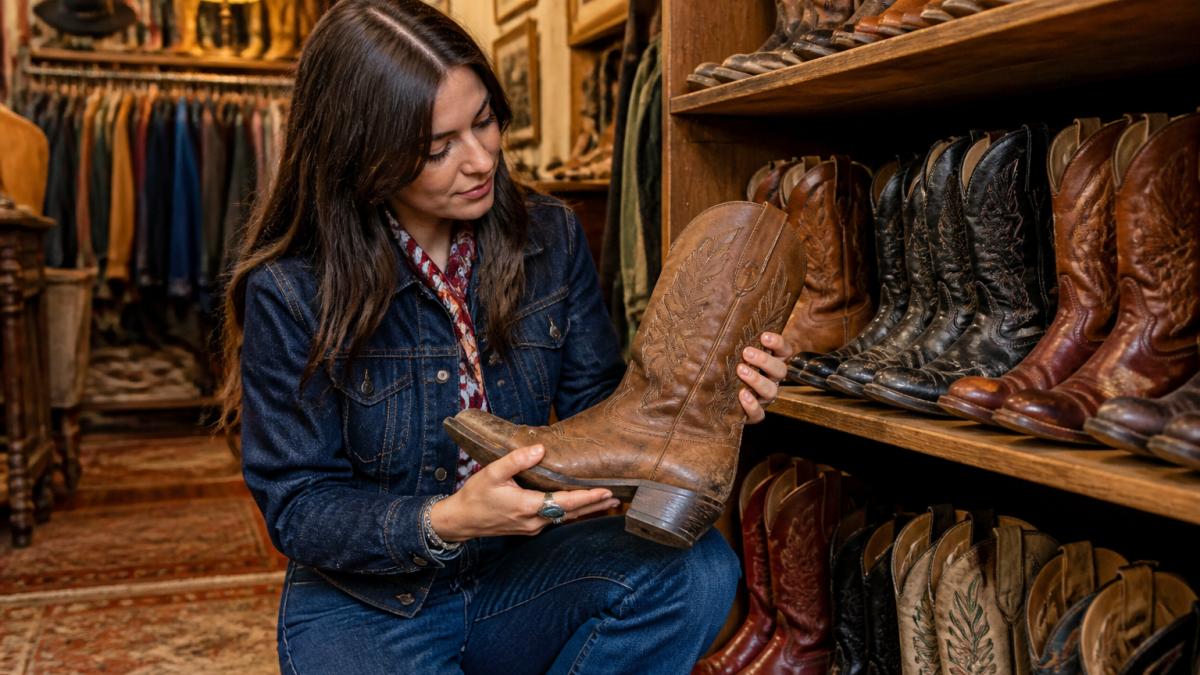
Regional clusters matter because boot-making heritage is regional. A shop in Austin stocks different makers than one in Seattle.
What to inspect in person:
- Press the leather along the vamp. It should flex, not crack
- Check the welt stitching for even spacing and no rot
- Look inside the shaft for the maker's stamp
- Walk on hard flooring, not carpet, to test the heel stack
How to Identify Authentic Vintage Cowboy Boots
Authentic vintage cowboy boots show hand-stitched welt construction, a leather outsole, and a stacked heel with visible layers. Fakes and modern reproductions usually skip at least one of those three.
Run this checklist before you buy:
- Leather outsole with visible stitching, not glued rubber
- Stacked leather heel, layered and nailed, not molded plastic
- Interior stamping with a maker name or union label
- Welt construction you can see from the side profile
- Patina that's uneven and natural, not sprayed-on distressing
- Toe shape consistent with the era (snip toe and square toe read older)
Exotic skins are where authentication gets hard. Ostrich skin has visible quill follicles, and smooth quill sections near the vamp are a strong sign of the real thing. Cowhide with faux texture won't have that irregular follicle pattern.
Vintage Cowboy Boot Sizing Guide
Vintage sizing is not a conversion chart, it's a measurement problem. Boot lasts (the foot-shaped forms a boot is built over) changed shape repeatedly across the 20th century, and a stamp that reads 9D from 1975 can fit like a modern 9.5 or even a 10 depending on the maker and the era. The only reliable method is to ignore the stamp and work from measured dimensions.
Ask every seller for these numbers, taken with a soft tape inside the boot:
| Measurement | How to Take It | What It Tells You |
|---|---|---|
| Ball width | Tape across the widest part of the footbed, inside | Whether the boot is a true D, EE, or narrower |
| Heel-to-toe length | Tape from the inside heel seam to the tip of the toe box | The functional length, which is what your foot actually occupies |
| Shaft height | Tape from the top of the heel counter to the boot opening | How it wears with jeans, skirts, or tucked |
| Heel height | Tape from the ground to the top of the heel block | Affects posture and how the arch sits |
| Instep girth | Tape around the highest point of the footbed | Catches high-arch fit problems the length won't reveal |
Compare the ball width and heel-to-toe length to a pair you already own that fits well. Measure your own boot the same way, then match. That single step eliminates most sizing errors, because it bypasses the stamp entirely.
Width lettering is its own trap. Older boots often used narrower letter designations than modern ones, and some makers stamped width as a number rather than a letter. A boot marked "B" from the 1960s may fit closer to a modern "A" or "AA." When in doubt, size to the wider measurement and add an insole, leather stretches with wear but never shrinks back.
Toe shape changes fit as much as size does. Snip toes and pointed toes run narrow through the ball and can pinch even at the correct length. Square toes and rounded ropers run roomier and are more forgiving for wider feet. If you have a high instep, a roper or wide square toe will almost always fit better than a snip toe in the same stamped size.
Shaft height is a styling decision as much as a fit one. A 10-inch shaft tucks cleanly under straight-leg denim. A 13-inch shaft needs a bootcut or a skirt to sit right, and anything taller starts to read as a statement piece.
Finally, break in slowly. Wear new-to-you vintage boots for an hour at a time on carpet before committing to a full day. Leather that has been sitting for decades needs time to warm and conform, and a boot that feels tight on day one often fits perfectly by day five.
How to Restore Vintage Leather Boots
Restoration starts with cleaning, then conditioning, then polishing, in that order. Skip a step and you'll trap dirt under the conditioner.
Follow this sequence:
- Brush off loose dirt with a horsehair brush
- Wipe the leather with a damp cloth and let it dry fully
- Apply leather conditioning cream in thin layers, working it into creases
- Let the conditioner absorb for 20 minutes, then buff with a cloth
- Apply cream polish matched to the leather color
- Treat the sole edges with a leather dressing to stop cracking
Distressed leather needs less product, not more. Over-conditioning softens the structure and the boot loses its shape. Exotic skins like ostrich need a conditioner made for reptiles, since standard creams can darken the quill pattern.
For structural damage, welt separation or a worn stacked heel, go to a boot repair specialist. A resoleable welt construction means the boot can outlive you with proper care.
What to Expect When You Buy Vintage Cowboy Boots
Expect variation, and expect to pay for condition. A pair with a leather outsole and original welt will cost more than a glued-sole pair in the same style. That price gap is real value, not markup.
Know the trade-offs going in:
- Final sale policies limit your recourse on fit and condition
- Sizing conversion means you should measure, not trust the stamp
- Condition grading varies by seller, so ask for specific photos
- Shipping from specialty shops can take longer than marketplace orders
At Gold Dogs, we've built our inventory around that reality. Every piece, from a distressed leather jacket to a pair of collectible boots, gets checked before it hits the floor. We're family owned and operated, we've been at it since 2011, and we ship free on U.S. orders over $75. First-time customers get 10% off, which takes some of the sting out of trying a new shop.
Frequently Asked Questions
What should I look for when buying pre-owned western boots?
Check the leather for deep cracks, especially at the flex points. Look at the sole and heel for uneven wear. Inside, make sure the lining isn't torn and the insole isn't molded to someone else's foot. Ask about the return policy. Many sellers enforce final sale, so if you can't inspect in person, request detailed photos of the toe, heel, and stitching before you commit.
How can you tell if vintage cowboy boots are real leather?
Real leather has a natural grain and soft sheen. It wrinkles when you press it, while synthetic materials crease sharply or feel plasticky. Look at the edge of the sole: leather outsole layers look like stacked fiber, not uniform rubber. Inside, check for a leather lining and a stitched welt. If the price seems too low for a handmade boot, it's probably synthetic.
Are vintage cowboy boots worth anything?
Some are. High-quality vintage boots can sell for over $1,000, with rare pairs going for much more. Value depends on brand, leather type, condition, and rarity. Exotic skins like ostrich or smooth quill often command higher prices. Even mid-range vintage boots hold value if the leather is in good shape and the soles are resoleable. Check completed sales on marketplaces to gauge current demand.
How do I know if vintage boots will fit if I can't try them on?
Ask for measurements: total length, width at the ball, and shaft height. Compare those to a pair you already own. Vintage boots often run a half size smaller than modern sizing, and widths vary. If the seller won't provide measurements, walk away. A good fit means your heel stays down and your toes have room to wiggle without sliding forward.
Vintage boot shopping rewards patience and punishes impulse. The right pair, properly sized and cared for, will outlast anything off a fast-fashion rack. If you want a curated selection without the marketplace guesswork, Gold Dogs stocks vintage and new western pieces with the rock 'n' roll edge that makes them worth wearing. Browse the collection, grab 10% off your first order, and find the pair that fits your style without rules.